mountain man
Stefan Mostert
10 August 2025
2,250 words
20 minutes
Searching for remoteness on The Devil’s Highway
I’ve always been drawn to the lives of the old mountain men—those who once traversed the American continent in its wild days: trapping, hunting, fishing, smoking, riding and exploring.
Their lives were spent outdoors, almost every moment of it. They knew the sun, the moon, and the stars. They could read the land and understand the mountains. There’s always been something about that lifestyle that speaks to me.
But the reality, of course, was far less romantic. These seemingly attractive lives were dominated by what has consumed humanity for most of history: fighting. Fighting with people, fighting with animals, fighting the elements, fighting for life on a daily basis.
Yet there must have been something riveting about always living so close to the edge. Every time you survived a battle, crossed an ocean, or endured an icy winter night beside the ashes of a campfire, it must have sparked a renewed appreciation for everything and everyone around you. Life must have felt far more sacred—something that could be lost more easily.
In today’s world, most of us are no longer forced to live on that edge. We’ve traded mere survival for extreme comfort. We’ve gained a lot, but also lost much.
So, if given the choice, what would we choose? The raw, elemental life of the old mountain men—full of natural adventure, but also constant danger and violence. Or today’s world, where nature comes only in curated moments, but everything in between passes relatively peacefully.
What I admire most about long-distance cycle touring is that it lingers between these two worlds: the wild days of our past, and the more civilized time of today. Touring can be dangerous, but not outrageously so. You might face a storm, get lost, or run out of water. But it remains an escape—something outside your normal life. You’re not surviving nature; you’re just visiting. You’re not living off the land, you’re just moving through. There is an edge, but it is padded by a credit card and a cell signal.
By now, I’m used to being sidetracked when preparing for a cycle tour. All that uncertainty bringing procrastination and doubt. The uncomfortable, worrying feeling that makes you question everything. Should I go? Should it be this route? Do I have enough supplies? Have I done enough research? Something usually goes wrong at some point, and so I ask myself where, when, and what will it be this time?
But that feeling means I’m stepping outside my comfort zone, opening to something new. And from that, adventure and discovery usually spring. Most importantly, it makes me check myself. So, I pack diligently, check my lists thoroughly, study my maps attentively, and plan my supplies with care.
My departure point is a ranger station at a nowhere place called Three Way, Arizona. I’ve arrived by car from one way, I’ll leave by bike on the second and—if all goes well—return from my journey along the third.
Three roads, a shacky gas station, and a ranger station, all of it dominated by a massive, old billboard-type structure that I later learn is an abandoned microwave signal reflector.
Inside the ranger station are the friendly faces you always seem to find in places like this. These land stewards always look very happy and content—maybe because they spend most of their lives outdoors. I like to think they carry some remnant of the old frontier spirit: the mountain ‘men’ of today.
I remind them that I called earlier in the week, and they confirm I’m welcome to leave my car here for a few days. I’ve roughly traced a 220-mile loop on my map, almost entirely across public lands. Half the route follows Arizona’s famed Devil’s Highway—a lonely road that slices through the White Mountains and the Apache-Sitgreaves National Forest.
Over the next two days, I will slowly climb onto the Mogollon Rim, the southern edge of the Colorado Plateau that separates Desert Arizona from Alpine Arizona. In fact, up on top is a place called Alpine, which will be the farthest point on my route and the place I’ll turn around. Two days up, two days down.
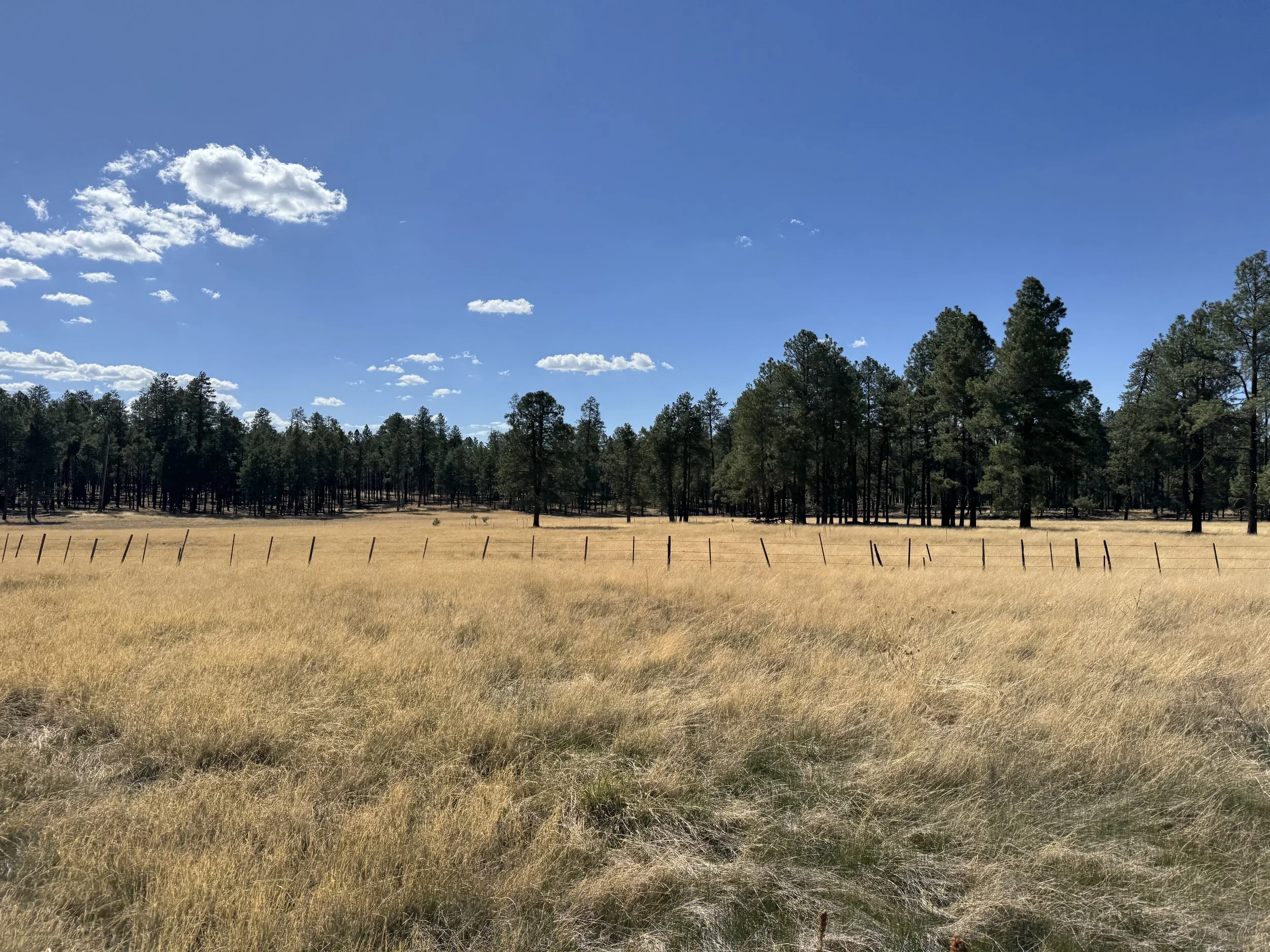
Around 10 a.m., I’m parked, packed, and geared to go. With my loaded bike, I push into the foothills of the White Mountains, which roll like the hills in Arkansas—you keep going up and down, but your elevation changes little.
In the late, hot afternoon I enter New Mexico. I lie in the long, narrow shadow of a ponderosa pine. These tall trees and their stubby cousins, the piñon pines, offer little shade and even less cover—making wild camping a challenge. I slowly realize I’ll need to push through to the next town: Glenwood. There is a campground—but it requires another three hours in the saddle.
So I cycle on and, just before sunset, arrive at Glenwood’s Big Horn Campground—a sad and dry affair right beside the main road. The ground is dusty, rocky, and uneven; the picnic tables sun-bleached and splintered. I light a fire for dinner, the dry kindling catching quickly. I feel exhausted, almost annoyed that I have to eat—seeing it as the only thing standing in the way of me stretching out on my sleeping pad.

I wake up at sunrise and take on what turns out to be a very challenging day, heading up the Mogollon Rim. I’m reminded that most of the time on a cycle tour is spent going uphill. Compared to your slow climbing speed, the moments you spend going downhill are mere fleeting events. That is, of course, one of the most alluring aspects of riding downhill on a bicycle—it’s an intensely enjoyable but finite experience.
So you’d better enjoy the uphills—otherwise, you’re in for a miserable time. This is what I keep telling myself as I climb for most of the day. It’s the mind that needs to be convinced about these adventures, not the body.
I finally reach my destination for the day, a campground called Upper Blue. I pitch my tent just in time for a massive rainstorm. As I lie safely inside, I constantly check the tent seams for leaks, but my little home holds up well. After the storm, I cook my meal and visit the riverbank to wash my face.
Later, I turn in—disheartened as a very challenging day turns into a challenging night, with body aches and pains keeping me awake for most of it.
I know it always takes a few days for my body to adjust to such a sudden and dramatic change, but still, I feel defeated. I’m reminded of cycle touring’s most demanding feature: it’s almost impossible to give up. You can’t just stop. No matter how tired or sick you may feel, any plan to quit still requires more effort. I decide to keep going to the next town and see how I feel by lunchtime.
I kick off my third day with another long uphill, daydreaming about one of those friendly small-town American diners—the kind that always has a burger and fries on the menu. I find just that place in Alpine, called the Bear Wallow Café. I order the “Cowboy Burger” and settle in for a slow meal while my electronics charge.
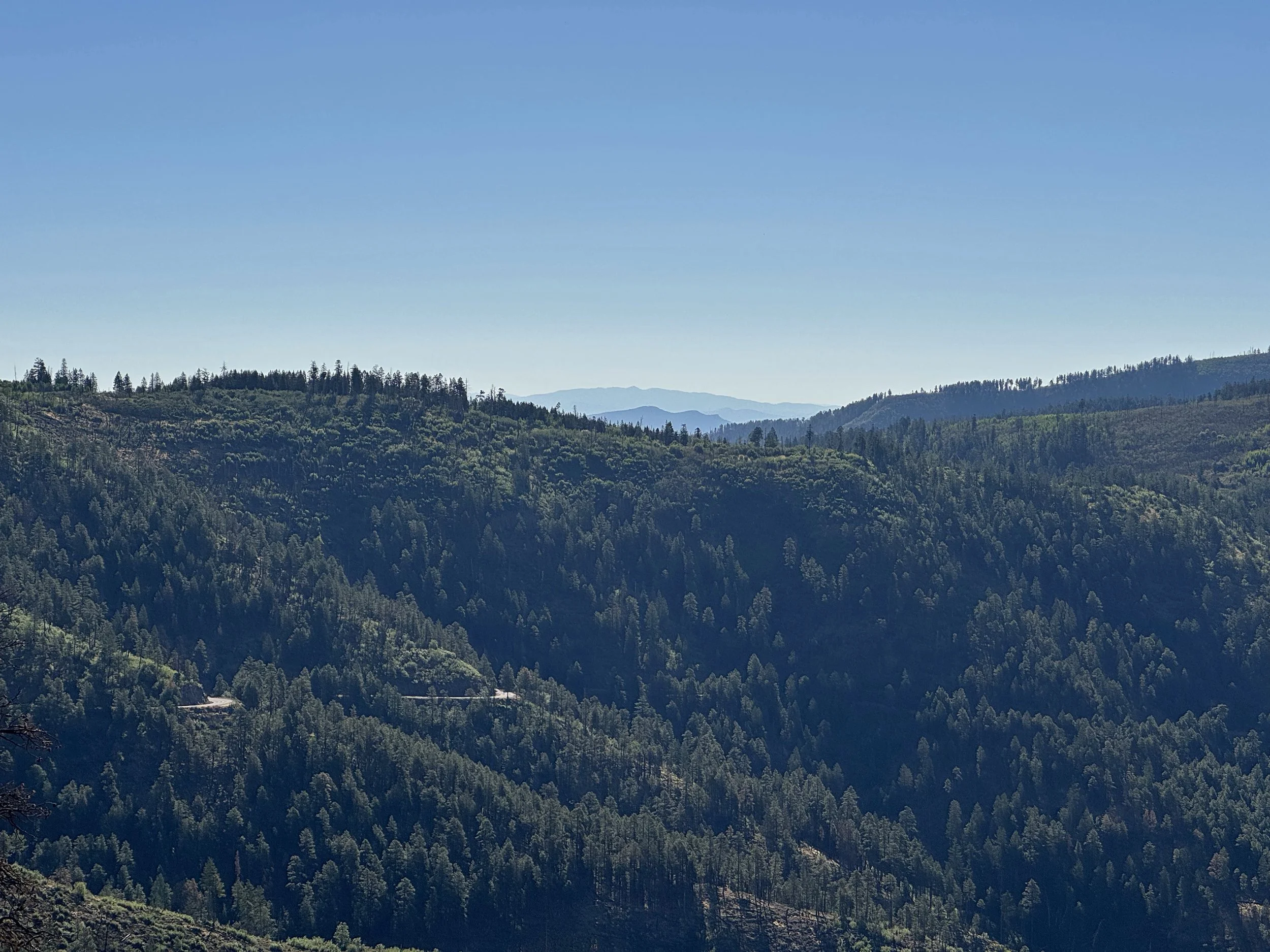
Soon, I feel revived. I study my map again and plan the second half of my journey with renewed energy and will. My route south will now follow the Devil’s Highway—officially known as the Coronado Trail—a paved scenic byway that, as far as I can tell, motorists only ever drive once. Nobody returns. They will ask me, “You’re going down that road?” But that’s in a car. On a bike, roads like this are pure joy: very few cars on long, winding downhills with a new view around every bend.
Although I’ve reached the halfway mark in distance, I haven’t yet reached the highest point of the journey. So, I continue climbing after lunch and, in the early afternoon, arrive at my high point: a green, cool, and welcoming campground called Hannagan. It sits quietly at 9,100 feet, with just enough other visitors to form a serene and temporary settlement for the night.
I set up camp while Pink Floyd drifts in from my neighbor’s site. Later, I start hearing occasional loud screams of “Yeah!”—the universal sound of alcohol. Then comes the inevitable visit from said drunk neighbors. A couple stumbles sideways toward me, their heads in a drunken slump. I get the usual questions: Am I alone? How far do I ride in a day? What about the cars? We chat for a while, then they drift off before we can properly introduce ourselves. As they walk away, they casually warn me about a small bear that makes his rounds here at night.
I had been reluctant, but now decide to hang my food from a tree downwind—anything to give my mind some peace tonight.
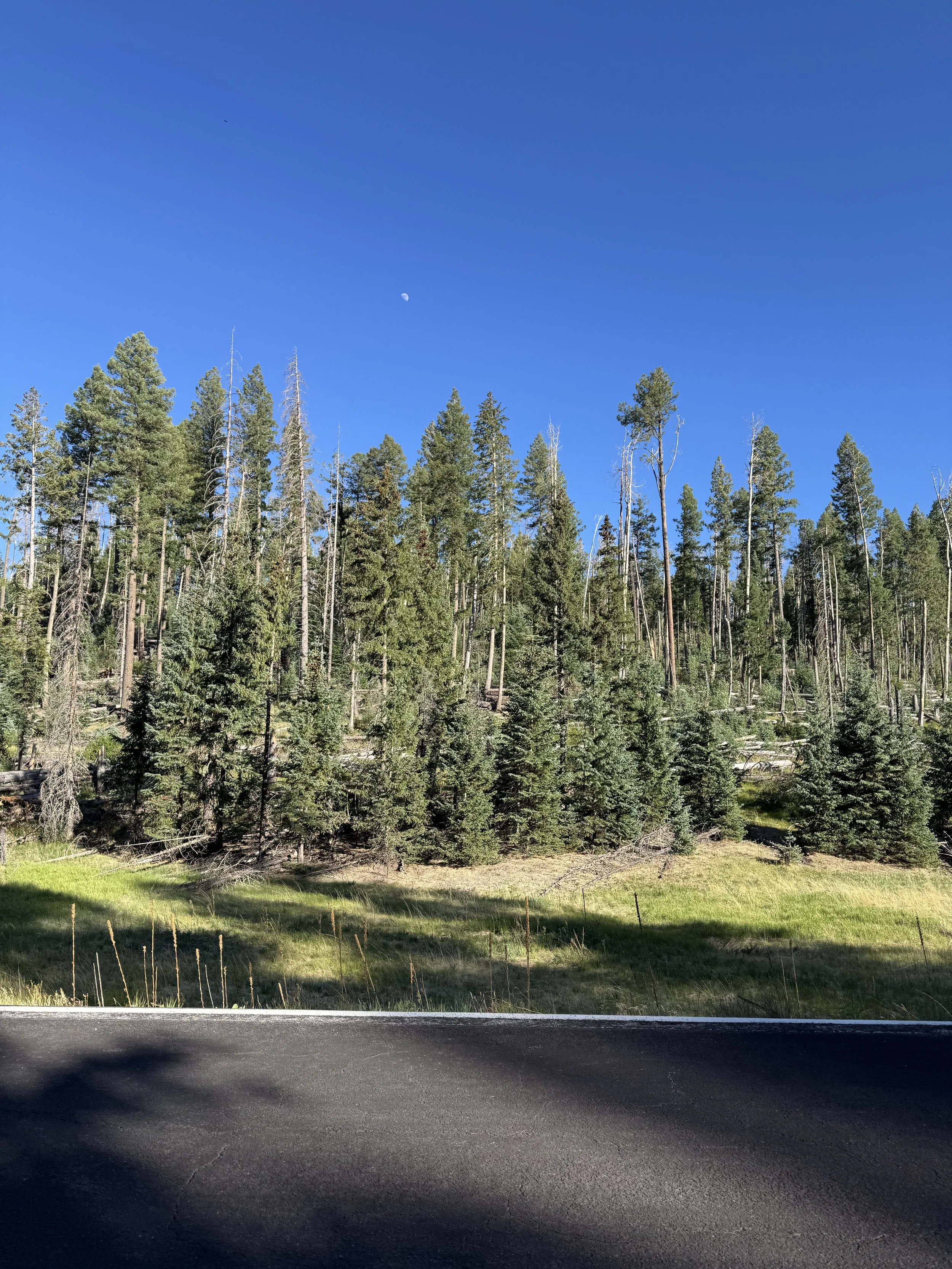
On my last morning, I wake up with the sun. Outside my tent is a hum of birdsong, the buzz of a hummingbird, and—every other moment—the repetitive hollow clunks of a woodpecker’s beak on bark. When you feel vulnerable in the wilderness, you have more appreciation for new mornings.
I make a small fire for some coffee, pack up camp and load my bike. When everything is ready, and I only have to put on my helmet, I pause for a quiet, caffeinated moment before the day’s movement begins. I say goodbye to my red-eyed neighbors and continue on the very quiet Coronado Trail.
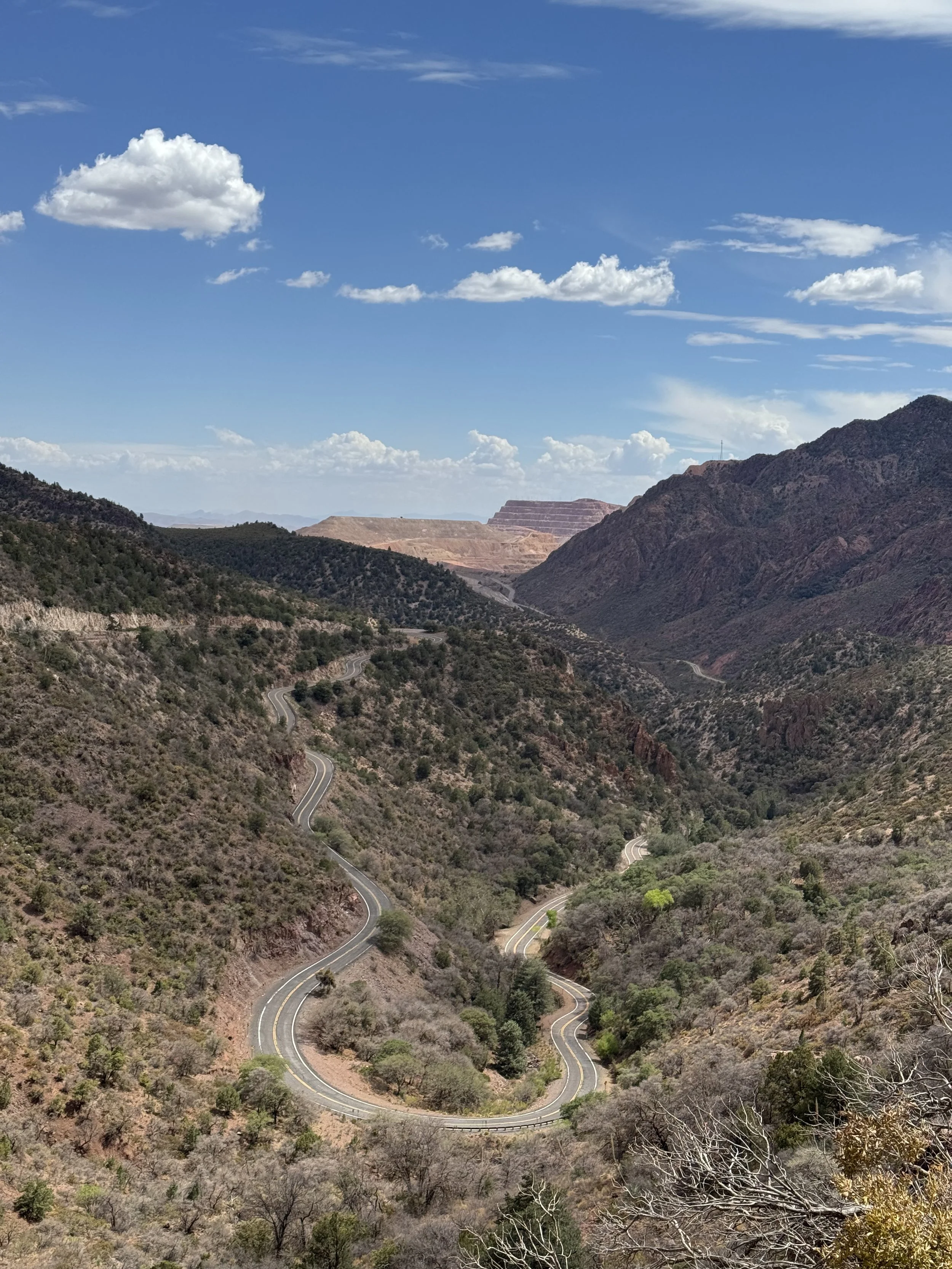
The road is named after Francisco Vázquez de Coronado, a Spanish conquistador who passed through this region around 1541 during his unsuccessful quest to find Cíbola—one of the fabled Seven Cities of Gold. Known for its sharp curves and steep drop-offs, Arizona’s Devil’s Highway was once U.S. Route 666—renamed due to superstition and frequent sign theft. The road lives up to its name. The curves are sharp, the gradients steep, and a sheer drop runs continuously along the edge.
I ride through cool mountain air, looking forward to the 5,500-foot descent that will eventually return me to the desert today. But that’s also where the intense heat awaits, so the feeling is bittersweet.
Soon I settle into my usual riding ritual: cycle for a few hours, find shade, throw out my tarp, lie down, reset my muscles and look at the sky. Then, repeat.
Late in the afternoon, in the heat of the desert’s western sun, I enter the largest copper mine in North America: Morenci. So vast it takes me two hours to cycle through. The mine even features a “Scenic Overlook,” offering an elevated view of the colossal destruction that has reshaped this landscape over the past 150 years.
I’m struck by the stark contrast between where I am now, and where I was just ten minutes ago. The form of the land remains, but the surface has been transformed into an undulating landscape of rock and sand. You might see something grow through a crack in a road, but here in the red expanse of the mined terrain, there is no sign of life. A fine red dust also hangs in the air and clings to every surface. Enormous machines roar, and beep-beep noises come and go. On top of it all, it is sweltering hot. Has the Devil’s Highway led me to hell?
I think about how we often look down on landscapes like this—and on the people directly involved—while ignoring the fact that each of us shares in the destruction. They do the dirty work, but we’re the ones pulling the strings from a distance.
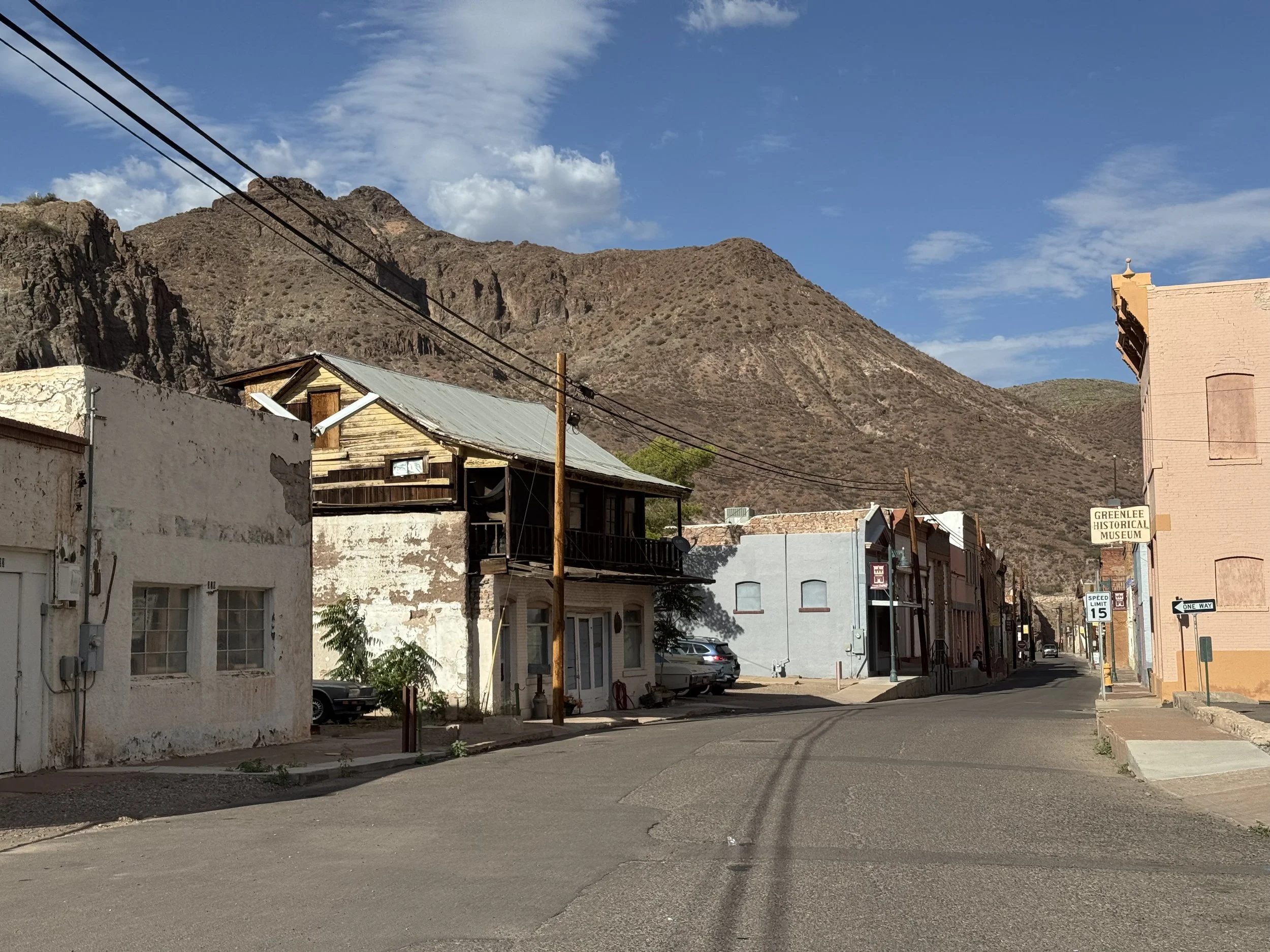
Just outside the mine, I find a gas station and fill every container I have with ice. The last stop of my tour is Clifton, Arizona—a historic mining town made up of one beautiful, deserted, story-filled street. I cycle through it and carry on toward Three Way.
With the sun low on the horizon, I take on the final few miles of my journey. Excitement builds—the feeling of completing a challenge while looking forward to life’s most basic pleasures: a shower, a meal, a bed. Soon I see the dilapidated microwave signal reflector, far on the horizon.
My mind wanders again to the mountain men—how they didn’t return from the wilderness to society, but rather from society into the wilderness. Home is where the heart is, and their hearts were in the wilderness.
My heart, too, is in the wilderness, but it’s also in the city. I look up to the mountain men, but I also feel inspired by modern men and women—by the humans of my time.
In Ghost Train to the Eastern Star, Paul Theroux writes: “Travel is at its most rewarding when it ceases to be about you reaching a destination and becomes indistinguishable from living your life.”
The mountain men were not traveling; they were living their lives. After a few days of touring, a cycle journey also ceases to be about destinations, distances, and climbs, and simply becomes a way of living your life in the open.