adventūra
stefan mostert
11 october 2026
3,011 words
15 minutes
how we try to find what once found us
There is a golden stream of consciousness that flows through my mind (and into my pen) once I give my body over to continuous movement. It is the feeling you get from a good workout, only now it comes with the winds of a wild land blowing through your face. Then you take that feeling and repeat it for days, weeks, even months at a time. For me, that is touring by bicycle. But it could be anything with the same key ingredients: physical exertion while being outside with a map and a goal.
The goal is adventure: searching for and discovering distant places and those moments big enough to grab hold of you, but not so big that they won’t leave you alive and well. Of course, not every moment along the way is exhilarating. Most are not. But there are enough of them to make the search worthwhile. So you ride the wave: up and down, smooth and rough, easy and hard.
From here I began to wonder: what if I could intensify those moments by assembling a bespoke journey — a fictional quest — made up only of the most memorable experiences I’d ever lived? What would such a tour look like? Where would it begin, where would it go, and where would it end?
Day 1 would probably start with a gradual climb, somewhere in the Andes. I’d go up the valley of a dilapidated mountain town on a cool spring morning, with swaths of smoke signifying life around the scattering of houses below. The road would slowly take me higher, into cooler, thinner air, on a day-long expedition where there is no reprieve from the incline, no flattening of the path ahead, just a steady, unbroken push upward that lasts the entire day.
I’d start here because it offers all the right ingredients: friendly mountain folk, little food markets, fresh mountain springs, sweeping views across immense landscapes, and small, quiet roads disappearing over dramatic passes. In other words, I have chosen a place where adventure seems almost guaranteed.
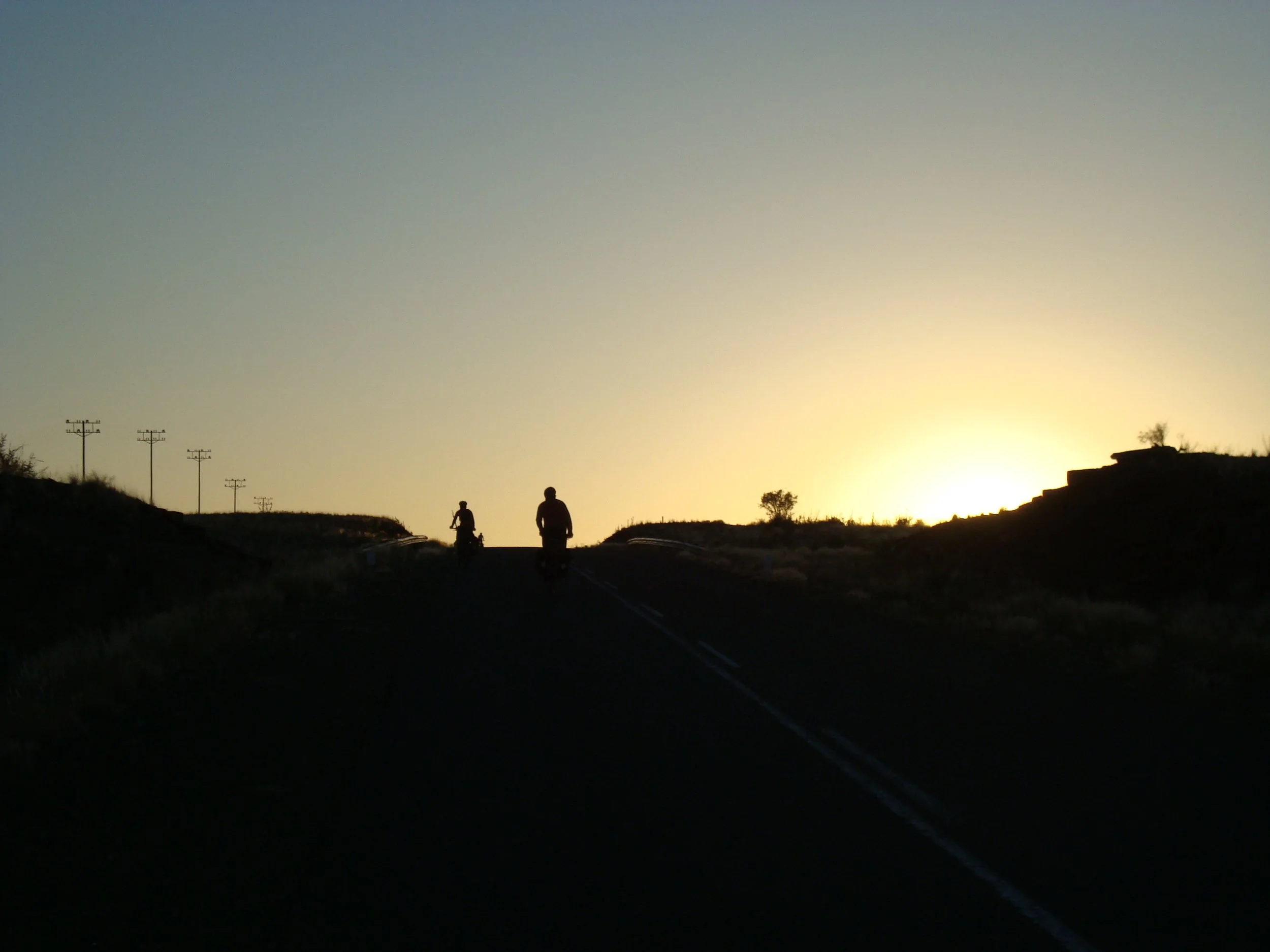
sunset ride in namibia
This is adventure in the modern sense: we set up a few key ingredients, make a plan and off we go! But when we look at the history of adventure, we see that it used to be something that happened to you, rather than something you made happen. It was the event that interrupted ordinary travel. More something that befell you, than something you tried to befall.
The word itself carries this older meaning. Adventure reaches back to the Latin verb advenīre: to come, to arrive, to come toward. From it came adventūrus — that which is about to come — and adventūra: a thing about to happen. Therefore adventure originally referred not to recreation or the deliberate pursuit of risk, but to events yet to come: occurrences unfolding along the path of a life already in motion. In this sense, adventure was not separate from living; it was embedded within it.
A hike was a morning walk to work in the forest. A voyage at sea might mean discovering new lands. Observing the sun was how you told time. The rain meant something. Food often meant killing. Serious illness often meant death. Protecting yourself was the norm. What we now go looking for in the name of adventure was once simply part of being alive. Our lives were intertwined with nature; they were, in essence, the same thing.
Be careful what you wish for, they say. But the argument is not that disease, danger, poverty and premature death are desirable. It is that uncertainty and direct physical engagement were once less separable from ordinary existence. This leaves us between a rock and a hard place. We are programmed to seek comfort and predictability, but the more we find it, the less adventure-filled our lives become. The moments we most wish would not happen are often the ones that later become the biggest stories. I only need to look back at my own most memorable adventures to see that many of them were deeply undesirable at the time, but later became the stories I told most often.
If my cycle journey across Southern Africa ran absolutely smoothly, would I still look back and call it an adventure? If I never ran out of water, or didn’t hitchhike that one time my bike broke down, or I didn’t hear the hippos outside my tent on that other night…
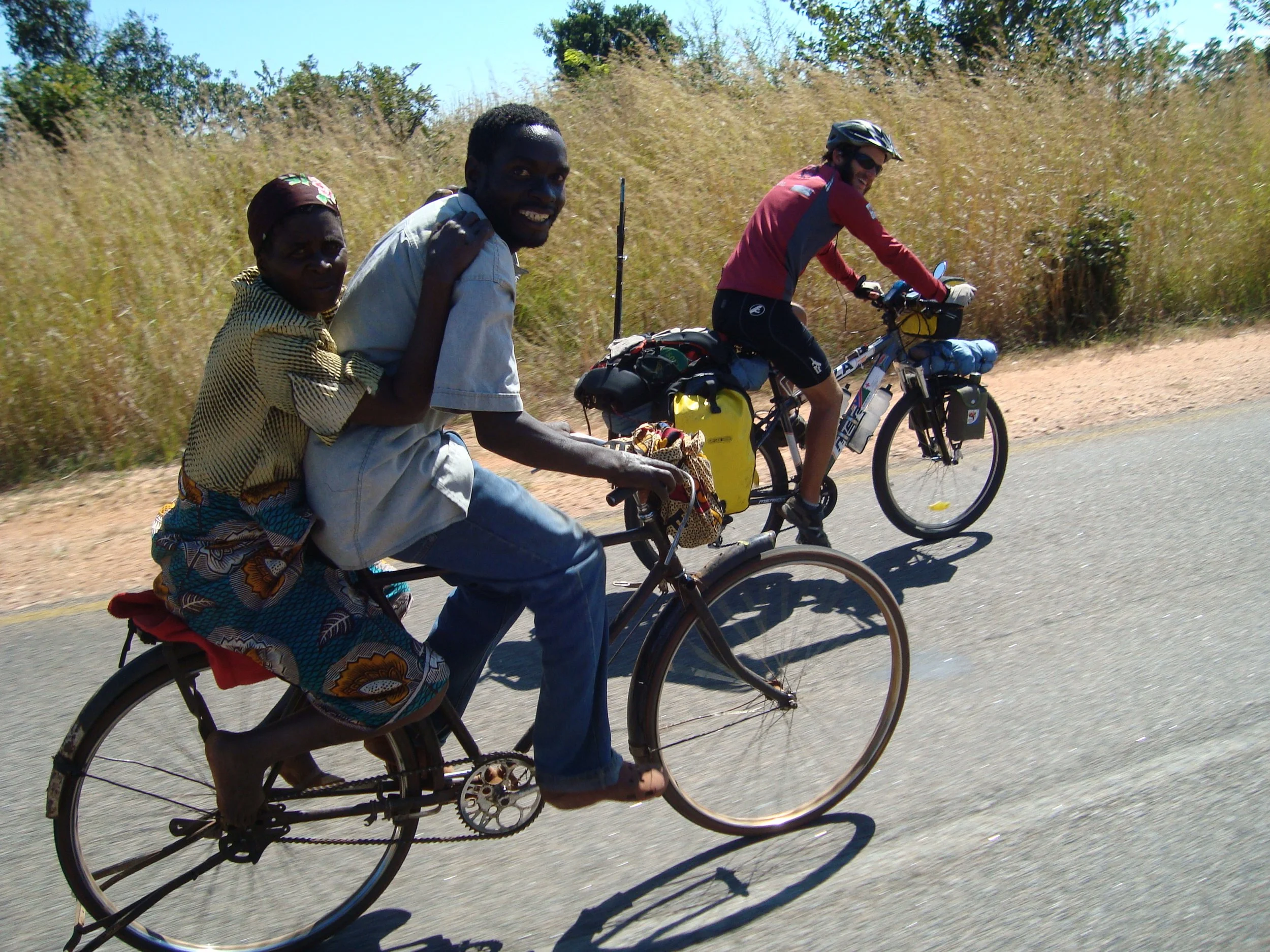
riding with the locals in zambia
Day 1, therefore, would not go according to plan. I would get more punctures than I had patches to fix them with, and I would catch a ride on the back of a mango truck, lying across crates and sacks alongside tired day laborers. My only view would be the clouds above, interrupted by roadside trees in blurring interludes. Clouds that would later become stars when I was dropped off in a town whose name I did not know.
On Day 2 I’d still have a couple of thousand feet to climb, just to seal the deal and intensify the downhill reward ahead. At the peak I’d catch my breath, take in a landscape where mountain peaks rolled away like hills, and then begin the long, slow descent into the adjacent valley. The gradient would be perfectly aligned with the preferred speed of a loaded bicycle. The roads would be quiet but paved, with the only thing interrupting the breathtaking views being more breathtaking views. Some days go according to plan.
Day 3 would take me to the shores of Lake Malawi, where, with the planned ferry failing to materialize, adventure would require me — and two good friends — to pay a local fisherman to take us and our bikes across to Mozambique in a small wooden boat. It would be a slow journey, baking in the sun and, every now and again, jumping into the crystal-clear waters of a beautiful African lake.
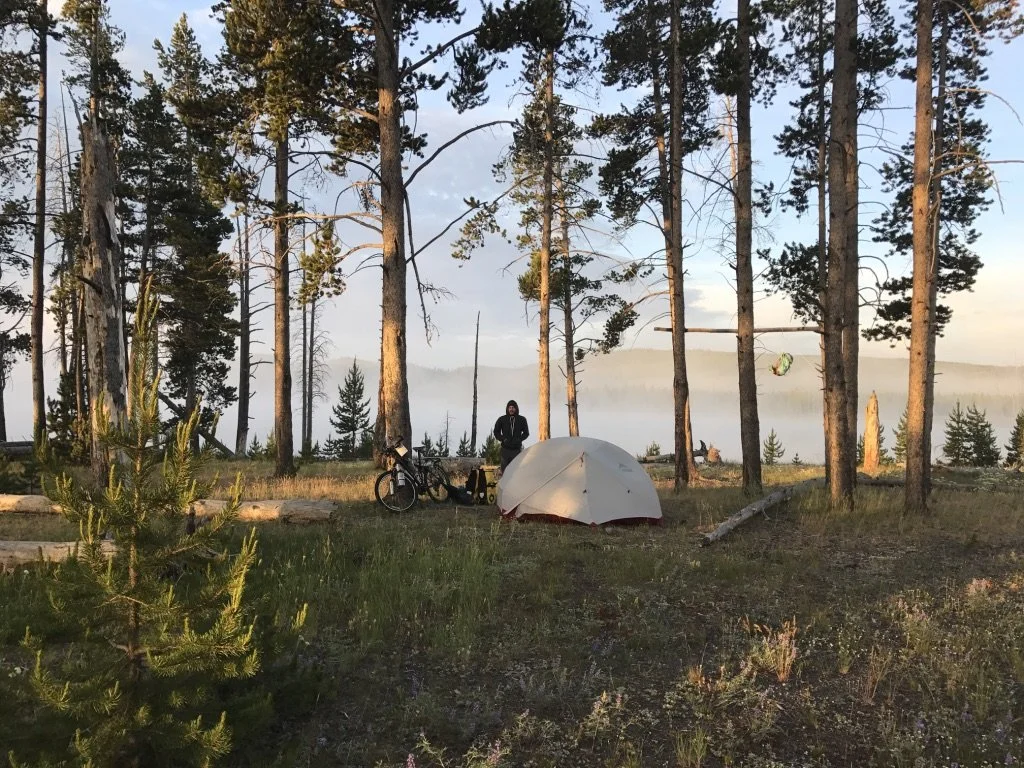
wild camp in yellowstone national park
Modern life, for a relatively privileged few, has all but eradicated many of the interruptions that once shaped ordinary existence. We now have a dial where we can turn their intensity up and down. For some, that dial should remain close to a minimum at all times; others decide to jump off a mountain in a wingsuit. The remarkable thing is that, increasingly, we get to decide where on that spectrum we want to live.
And yet, if observing my young children is anything to go by, curiosity seems to be one of our most persistent instincts. It is not enough for us to sit around in a field and eat grass all day. Boredom is painful. We need to move, discover and see what is out there. We do this by taking journeys, and it is on those journeys that we invite the possibility of interruption back into our lives.
Touring by bicycle serves this function particularly well. We load our lives onto a bike, put a pin on a map and make a plan to get there. And just like that, we expose ourselves to whatever might happen along the way while still holding onto a little control. Granted, there are exceptions, but for the most part we try to find that fine line where the challenge is something we can just, just endure.
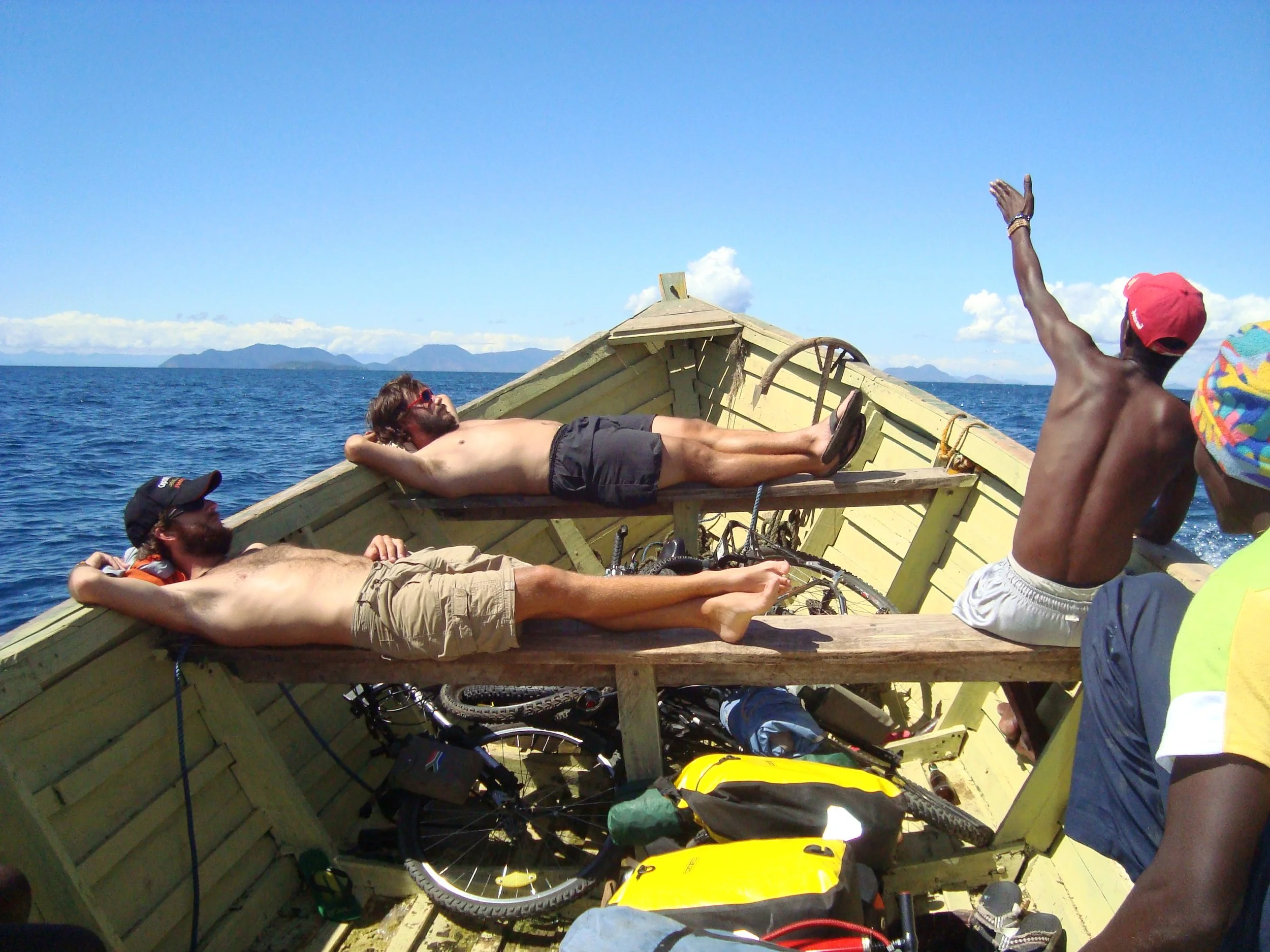
crossing lake malawi
But not every adventure needs to test the limits of endurance. On Day 4 of my fictional adventure, I’d take it easy and pass through any — or all — of the valley roads I’ve ever cycled. Those roads beside a roaring creek or river, where you can stop at any time to soak your feet — or your entire body — in clear, cool water. I’d find a flat, grassy spot for my tent, make a fire and watch day turn into night, after which the roar of flowing water would send me to sleep.
Yet sometimes the dial turns further than we intended, and in keeping with the theme, I’d throw one of my biggest interruptions into Day 5 of my imaginary itinerary. I’d cycle into the mountains of northern New Mexico in early spring, where patches of winter snow would slowly become humps of melting slush that I’d push my bike through. Fallen trees would eventually make it clear that the road had not been opened since the winter storms. But still I would continue, because turning around always seems worse than any other option. By late afternoon I would suddenly stop and realize that I was completely surrounded by white, standing in knee-deep snow with no road in sight. The sun would begin to set, and I’d make camp knowing that I might be lost, with the 20% battery left on my phone my only hope of finding the road again.
The next day, after finding my way down the mountain, I would lie back on dry ground, look up at the sky and enjoy a renewed appreciation for life — and for a visible road. That, perhaps, is what the greatest adventures ultimately provide us with: an episode that captivates our being in full, straightens our minds and allows a renewed perspective on life, love and everything.
And that raises a larger question: if adventure has been transformed into something we deliberately seek, rather than something that merely interrupts ordinary life, when did that transformation take place, and what influenced it?
Part of the answer lies in two luxuries. One was the privilege of viewing danger and difficulty as something to pursue rather than avoid — something that could make an experience worth having. As life became more tolerable, controlled and predictable, we began looking for interruptions of our own, particularly out in the wild.
Mont Blanc offers an early glimpse of this shift. The story begins in 1760 with a young scientist looking up at Mont Blanc and sensing adventure. Horace-Bénédict de Saussure was a Genevan naturalist with interests in geology, botany, physics and the atmosphere. On an early visit to Chamonix, Mont Blanc fascinated him enough that he offered a reward to whoever could find a way to its summit. For the next quarter-century, people tried.
There is something remarkable about the idea itself. Here is an educated European looking at a dangerous, apparently useless mountain and thinking: I want to know what is up there. Mont Blanc was not a pass that needed to be crossed to reach another valley. Nobody needed to reach its summit because of war, famine or trade. The summit was the destination. Saussure certainly had scientific motives, but something increasingly familiar to us was taking shape: deliberately entering a difficult landscape and undertaking a demanding mission simply because we were curious about what we might find there.
Then, in 1786, Michel-Gabriel Paccard, a Chamonix physician with scientific interests, and Jacques Balmat, a farmer and crystal hunter, made the first recorded ascent of Mont Blanc. The moment seems to capture something of its age: science provided the reason, technology the means, but adventure provided much of the motivation. An object of fear was becoming an object of desire. The altitude, ice, danger and complete uselessness of the destination were no longer merely reasons to stay away; they were becoming part of the attraction.
Another luxury was time. For adventure to become a pastime available to ordinary people, leisure itself had to become more widely available.
Adventure as a pastime appears first among people wealthy enough not to require a weekend. The European aristocracy — especially British men — undertook the Grand Tour, spending months or even years travelling through France, Switzerland and Italy as a finishing stage of education. Here something important was happening: travel no longer meant only trade, migration or pilgrimage. It could now be undertaken simply because seeing the world was considered worthwhile.
Humans have always had leisure. What is relatively new is the idea of leisure as a clearly bounded block of time that is ours to spend — and, even more recently, the idea that we might deliberately use that time to seek hardship, uncertainty and risk.
Scheduled free time arrived alongside scheduled work. Once industrial life began organizing work into increasingly defined intervals, it also created the possibility of organizing leisure into intervals of its own. One of these was the weekend, a word that did not enter widespread English use until the late 19th century. By then, Darwin’s Origin of Species had been out for decades, the United States had completed a transcontinental railroad, and Stanley was wandering around Central Africa. Even then, the weekend generally meant Saturday afternoon and Sunday. The familiar Saturday – Sunday weekend would only become a mass institution in the 20th century.
The weekend, then, was not the invention of leisure. It was the invention of scheduled leisure. And modern recreational adventure began to spread at almost exactly the moment industrial society became capable of making ordinary life less adventurous.
The bicycle arrived at just the right time.
In 1878, Britain’s Bicycle Touring Club was founded specifically for people travelling by bicycle. Then, in 1884, Thomas Stevens left San Francisco on a penny-farthing, crossed the United States, continued through Europe and Asia, and two years later completed what is generally regarded as the first bicycle journey around the world.
The mountain was no longer merely an obstacle. The road was no longer merely a way of getting somewhere. Both had become experiences worth pursuing for their own sake. A century and a half later, that same impulse still sends me off into the sunset, simply to see what lies between here and there.
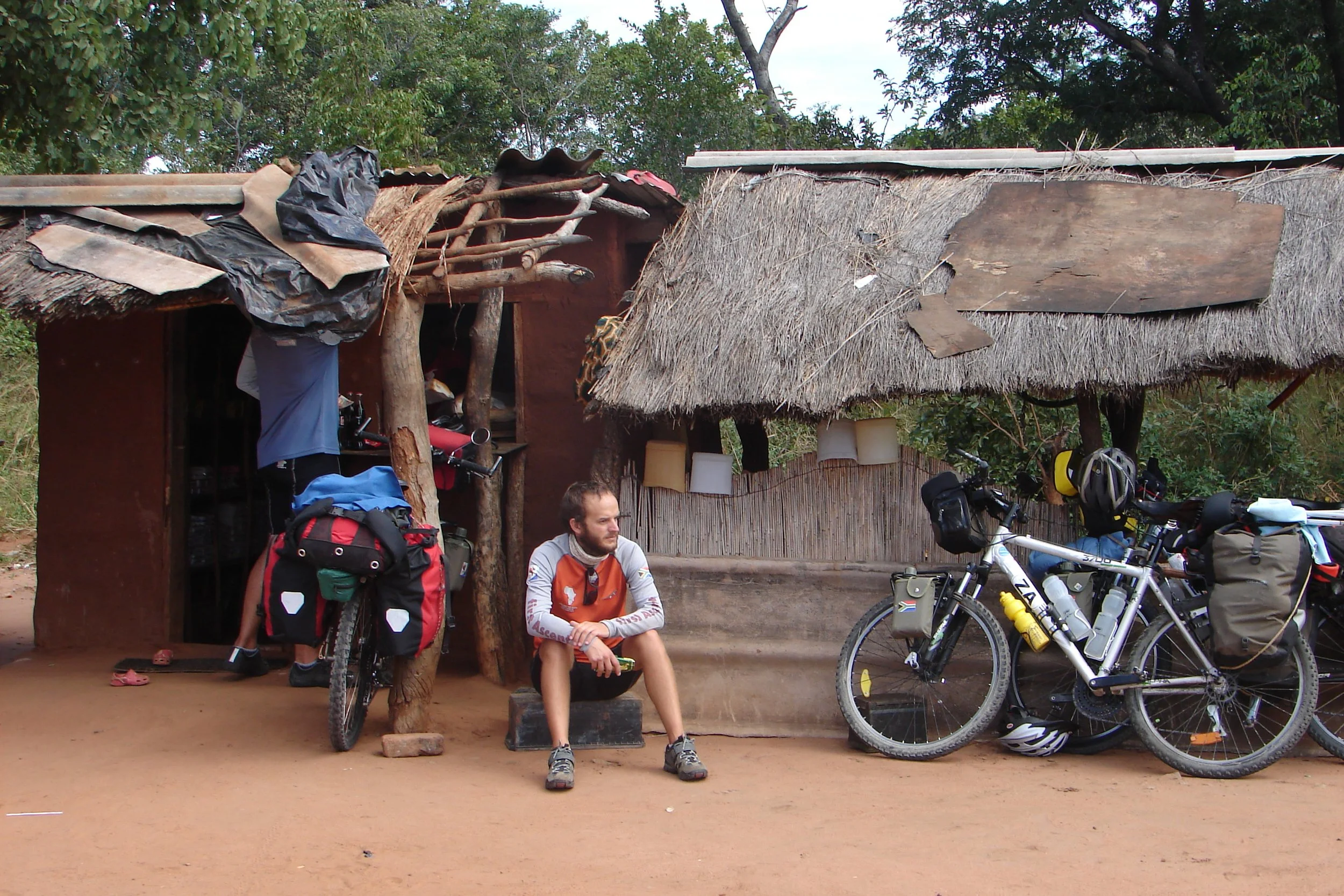
taking a breath in malawi
On Day 6, I would load my bike onto a train, get a sleeper, sit back and watch the world go by. I’d eat and wonder and ponder, drifting off every now and again while being rocked like a baby. Riding a train, for me, is very much part of the cycle touring experience.
Usually you just roll your bike on and walk onto the train. No boxes, no security check, no impatient personnel continuously nudging you along. Just pure travel while staying firmly on planet Earth. What’s more, the train is almost always delayed, which usually results in some last-minute rearrangement of Plan A into an adventure-filled Plan B.
We live in a world where speed and convenience have triumphed over experience and authenticity. The airplane annihilates distance, but the bicycle and train make you experience every inch of it. You watch the landscape change. People get on and off. Languages shift. Architecture changes. Food changes. Weather changes. You understand the distance because you have physically passed through it. On a bicycle, every mile has to be physically earned. A train ride, for me, becomes an extension of any bicycle journey. You’re still moving slowly through a world that would otherwise appear as small specks in an abstract and distant landscape from a jet. When I fly, I constantly long for the places below, imagining what it would be like to cycle or walk through each valley and over each mountain, inventing reasons to traverse them from my comfortable seat at 40,000 feet. From up there, the world begins to flatten into abstraction.
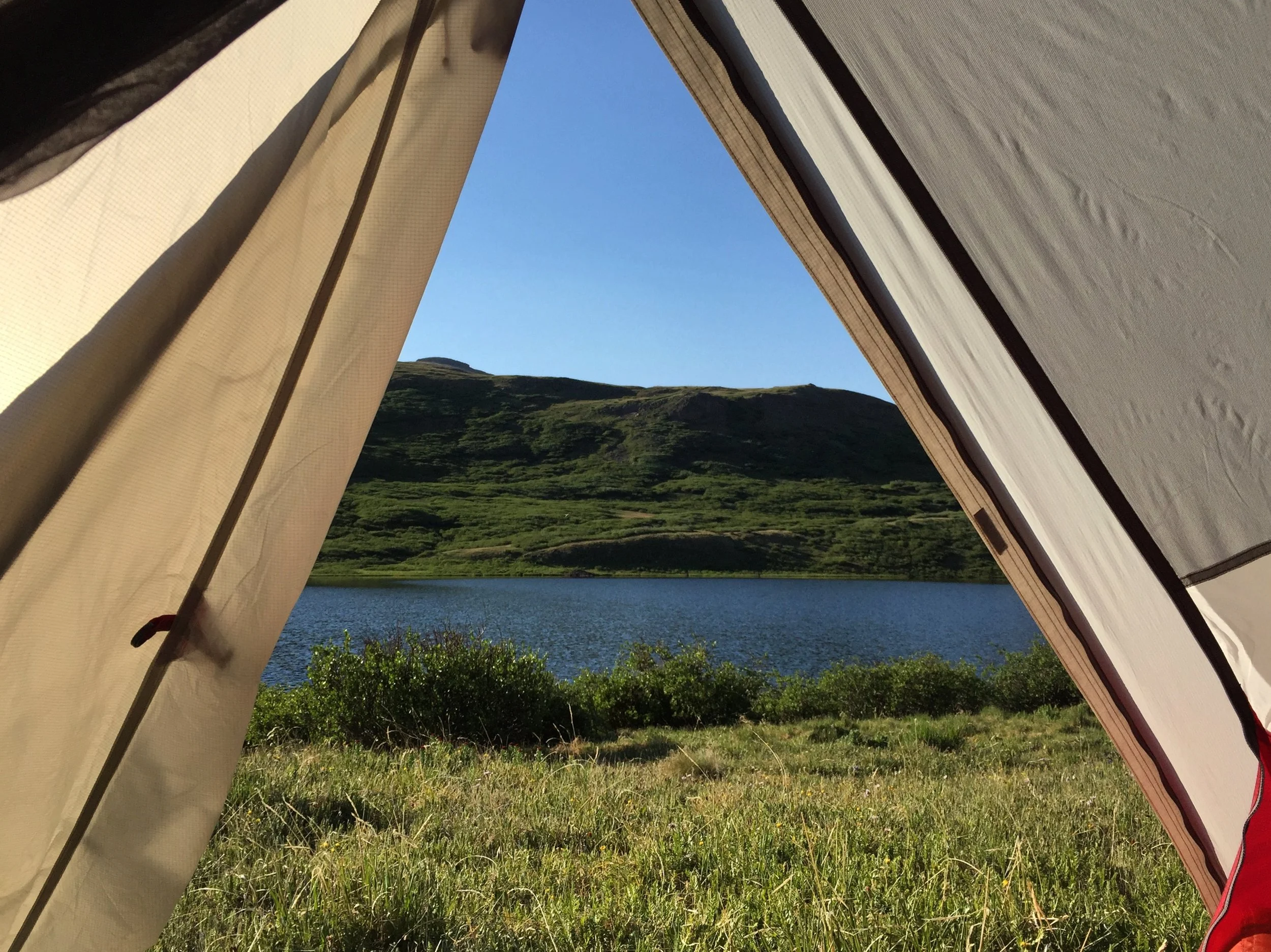
morning lake in colorado
And perhaps the screen is simply the next step in that progression. For most of human history, experience was difficult to separate from physical presence. To know a mountain, road, city, desert or ocean meant — in some meaningful sense — to encounter it. Then photography, film, television, the internet, Google Earth, virtual reality and now generative AI progressively loosened that relationship. We can see almost anywhere without going there. Increasingly, we can even enter worlds that do not exist. That creates a fascinating reversal: as representation becomes effortless, presence may become more valuable.
We are constructing an extraordinary system for ensuring that less and less genuinely arrives unannounced. Algorithms bring us what they think we want. Search gives us what we ask for. Navigation all but eliminates getting lost. Reviews tell us where to eat. Weather apps tell us when it will rain. Satellite imagery shows us the road before we ride it.
And adventure may therefore become partly an act of making ourselves available to what we haven’t requested. That is different from seeking danger. It means leaving some portion of the journey unresolved. Not knowing exactly where lunch will be. Not previewing every road online. Asking someone for directions rather than following the blue line. Choosing a route whose value hasn’t already been established by 4,000 five-star reviews. So perhaps the goal is not to seek ever greater hardship, but to become more receptive to what arrives. More receptive to adventure in its truest sense.
And here the whole idea of my perfect adventure runs into a paradox. In creating this adventure-filled journey, I have eliminated all chance encounters, all potential Plan Bs, because even they are baked into the itinerary. What I have created is not really an adventure at all, but a greatest-hits collection of perfect encounters. The perfect adventure would be a strangely lifeless thing, because perfection requires the removal of interruptions, and chosen difficulty is not quite the same as adventure. Adventure requires the world to answer back — to react to the original plan, to throw us into a diversion — something almost always received with reluctance and resistance, but which so often leads to unintended discovery.
So maybe on Day 7 I’d let the world decide. I would be dropped at an unknown coordinate somewhere on Earth, with my bicycle and whatever it could carry, and asked to reach the next place where I could find food and shelter. Yes, even a wild card would be a kind of plan — but a plan designed to leave room for the world to answer. Because adventure is not simply the elimination of direction, nor is it the creation of diversions. It is the acceptance that direction may change, that the pin on your map is almost never reached in a straight line.
The trick is not to know where adventure is waiting. It is simply to leave enough room in the journey for something unexpected to come toward us.